
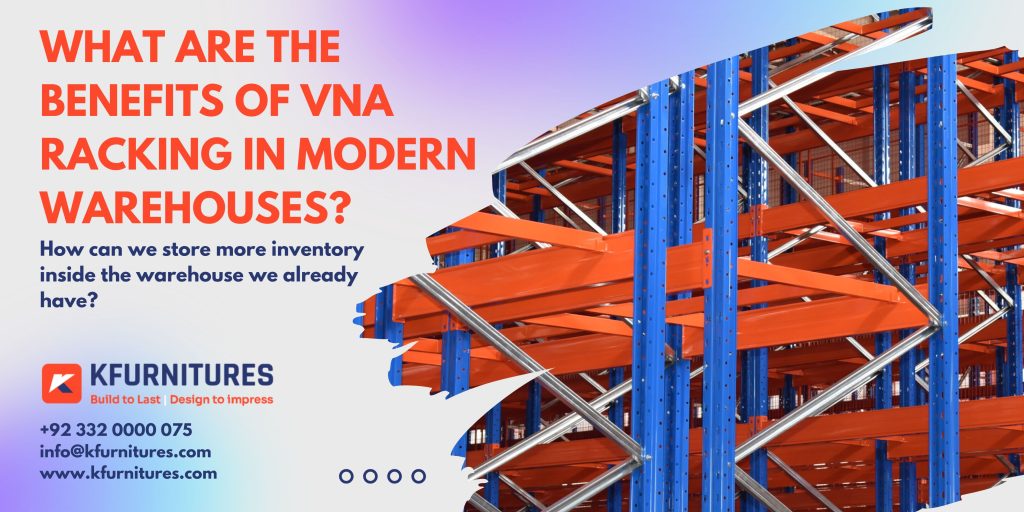
Warehouse Expansion Is Expensive — Smart Businesses Are Increasing Storage Capacity Without Moving Facilities
Warehouse costs are rising across every major logistics market. For many businesses, expanding into a larger facility is no longer the most cost-effective option.
Instead, operations managers are asking a smarter question:
“How can we store more inventory inside the warehouse we already have?”
The answer is driving a major shift toward VNA racking systems, high-density warehouse storage, and vertical space optimization.
Modern warehouses are no longer designed around empty aisle space. They are designed around storage efficiency, pallet accessibility, and cost per square foot.
For companies dealing with inventory growth, SKU expansion, or limited industrial space, high-density racking has become one of the fastest ways to improve warehouse performance without relocating operations.
Why Conventional Warehouse Storage Is Becoming Inefficient
Traditional warehouse layouts were built for flexibility — not maximum storage density.
Most conventional pallet racking systems create excessive empty space because they require:
- Wide forklift aisles
- Large turning radiuses
- Lower rack heights
- Reduced pallet density
As inventory increases, businesses experience:
- Congested warehouse movement
- Reduced picking efficiency
- Higher storage costs
- Poor vertical utilization
- Difficulty scaling operations
This creates a hidden operational expense that increases every year.
What Is High-Density Warehouse Racking?
High-density racking systems are engineered to maximize pallet storage within a limited warehouse footprint.
Instead of prioritizing wide access aisles, these systems optimize:
- Vertical storage height
- Narrow aisle movement
- Pallet positioning
- Warehouse cube utilization
The most popular solutions include:
- VNA (Very Narrow Aisle) racking
- Double deep pallet racking
- Drive-in racking
- Shuttle systems
- Mobile racking systems
Among these, VNA storage systems are becoming one of the most preferred solutions for modern distribution centers and industrial warehouses.
What Is VNA Racking and Why Is It Growing So Fast?
VNA (Very Narrow Aisle) racking is a warehouse storage solution that reduces aisle widths while increasing pallet storage capacity.
By narrowing forklift operating aisles, warehouses can install additional rows of pallet racking inside the same building.
Typical Aisle Width Comparison
| Warehouse System | Average Aisle Width |
|---|---|
| Conventional Racking | 3.5m – 4m |
| Reach Truck Layout | 2.7m – 3.2m |
| VNA Racking | 1.6m – 2m |
That difference may appear small on paper, but across an entire warehouse, it creates a massive increase in storage density.
How VNA Warehouses Improve Storage Capacity
The primary advantage of VNA systems is the ability to maximize both:
- Horizontal floor space
- Vertical warehouse height
Many warehouses use only half of their available vertical storage capacity.
Vertical Utilization Comparison
| Storage Layout | Average Vertical Space Usage |
|---|---|
| Standard Racking | 45%–60% |
| High-Density VNA Systems | 75%–90% |
By increasing rack height and reducing aisle width, warehouses can dramatically increase pallet positions without expanding the building.
Real Impact on Cost Per Pallet
One of the biggest reasons businesses adopt high-density warehouse storage is lower operational cost per pallet.
How Cost Per Pallet Decreases
When storage density improves:
- Rent is spread across more pallets
- Utilities support higher inventory volume
- Labor movement becomes more efficient
- Warehouse footprint requirements decrease
This means businesses can improve profitability without increasing facility size.
For many operations, the savings from optimized warehouse storage can delay expansion projects for years.
Why Warehouse Managers Are Prioritizing Space Optimization
Warehouse managers today face increasing pressure to:
- Handle larger inventory volumes
- Improve fulfillment speed
- Reduce operational expenses
- Support eCommerce growth
- Increase warehouse efficiency
At the same time, industrial property costs continue rising.
Because of this, warehouse optimization is no longer optional — it is becoming essential for operational scalability.
Forklift Systems Used in VNA Warehouses
VNA warehouses rely on specialized material handling equipment designed for narrow aisle movement.
Common equipment includes:
- Turret trucks
- Articulated forklifts
- Wire-guided forklifts
- Rail-guided VNA trucks
These forklifts allow operators to safely access high pallet positions while maintaining fast inventory handling speeds.
The right forklift compatibility is critical when planning a VNA warehouse layout.
Signs Your Warehouse Needs High-Density Racking
Many businesses wait too long before optimizing storage systems.
You may need a warehouse redesign if you are experiencing:
- Limited pallet space
- Overstocked aisles
- Slow forklift movement
- Inventory congestion
- Rising warehouse costs
- Frequent off-site storage use
- Difficulty scaling inventory
In many cases, the problem is not warehouse size — it is warehouse layout efficiency.
Benefits of High-Density Warehouse Storage
Increased Storage Capacity
Store more pallets inside the same facility footprint.
Lower Warehouse Costs
Reduce expansion and rental expenses.
Improved Inventory Accessibility
Better organization improves stock visibility and operational flow.
Better Space Utilization
Use vertical warehouse space effectively.
Future Scalability
Support inventory growth without immediate relocation.
The Future of Warehouse Design Is Data-Driven
Modern warehouse planning is shifting toward:
- Space optimization
- Storage density analysis
- Warehouse automation compatibility
- Faster inventory movement
- Reduced operational waste
Businesses that optimize warehouse layouts today gain long-term operational advantages in cost, scalability, and fulfillment performance.
Frequently Asked Questions About VNA Racking
What does VNA mean in warehousing?
VNA stands for “Very Narrow Aisle.” It refers to racking systems designed with narrower forklift aisles to increase storage capacity.
How much storage capacity can VNA racking add?
Depending on warehouse layout and ceiling height, VNA systems can increase pallet capacity by 30%–50% or more.
Is VNA racking suitable for all warehouses?
Not every warehouse requires VNA storage. Suitability depends on inventory type, operational flow, ceiling height, and forklift systems.
Does VNA racking require special forklifts?
Yes. Most VNA systems use turret trucks or articulated forklifts designed for narrow aisle operation.
What is the biggest advantage of high-density racking?
The biggest advantage is maximizing pallet storage while reducing cost per pallet and minimizing warehouse footprint.
Request a Warehouse Storage Consultation
At KFurnitures, we help businesses design smarter warehouse environments with optimized racking systems and storage solutions tailored for operational efficiency.
Whether you need:
- VNA warehouse planning
- High-density pallet storage
- Warehouse layout optimization
- Industrial racking solutions
- Storage capacity analysis
our team can help you identify the most efficient approach for your facility.
Request a Warehouse Storage Consultation today and discover how to increase pallet capacity without expanding your warehouse footprint.










 Huzefa Khambati - Partner