
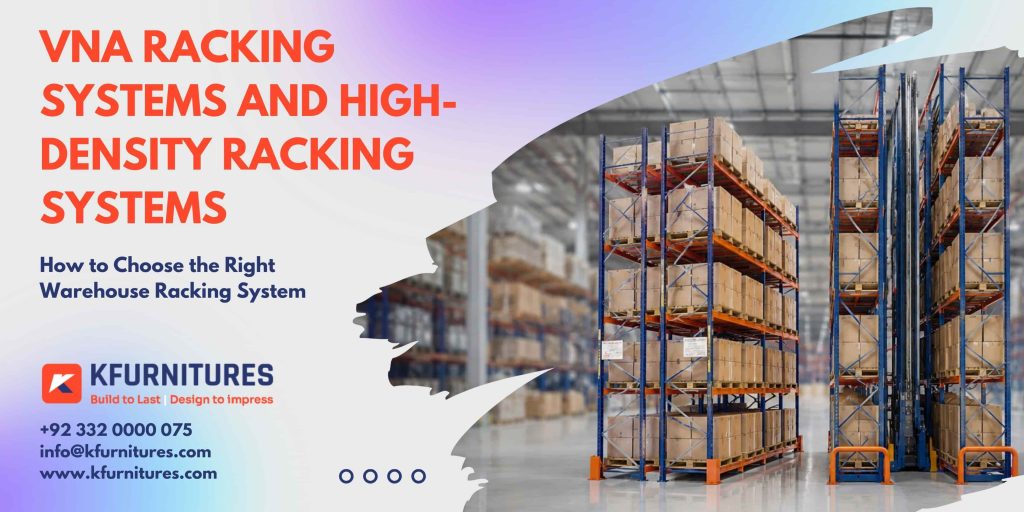
VNA & High-Density Racking Systems
As warehouse space becomes increasingly expensive and supply chain demands continue to grow, businesses are constantly searching for smarter storage solutions. Two of the most effective warehouse storage systems available today are Very Narrow Aisle (VNA) Racking Systems and High-Density Racking Systems.
These advanced storage solutions help warehouses maximize storage capacity, improve inventory management, increase operational efficiency, and reduce overall storage costs. Whether you operate a distribution center, logistics hub, manufacturing facility, or retail warehouse, implementing the right racking system can significantly enhance productivity.
This guide explains everything you need to know about VNA and High-Density Racking Systems, including their benefits, applications, differences, and how to choose the right solution for your facility.
What Is a VNA (Very Narrow Aisle) Racking System?
A Very Narrow Aisle (VNA) Racking System is a pallet storage solution designed to reduce aisle width and maximize warehouse storage capacity. Unlike conventional pallet racking systems that require wide aisles for forklift movement, VNA systems use specialized equipment that operates efficiently in narrow aisles.
Typically, aisle widths range between:
- Conventional Racking: 3.0 – 4.0 meters
- VNA Racking: 1.5 – 2.0 meters
By reducing aisle space, businesses can increase pallet positions without expanding their warehouse footprint.
Key Features of VNA Racking
- Narrow aisle design
- High vertical storage capability
- Direct access to every pallet
- Specialized VNA forklifts or turret trucks
- Optimized warehouse space utilization
- Improved inventory accessibility
Benefits of VNA Racking Systems
1. Maximizes Warehouse Storage Capacity
VNA systems can increase storage density by up to 40% compared to conventional pallet racking. More storage positions mean better use of available warehouse space.
2. Reduces Facility Expansion Costs
Instead of investing in additional warehouse space, companies can optimize their existing footprint by implementing VNA racking.
3. Improved Inventory Accessibility
Unlike some dense storage systems, VNA racking provides direct access to each pallet location, making inventory management easier and more efficient.
4. Better Vertical Space Utilization
Modern warehouses often have unused vertical space. VNA systems take advantage of higher ceiling heights, significantly increasing storage capacity.
5. Enhanced Warehouse Efficiency
With optimized layouts and dedicated VNA equipment, warehouse operations become faster and more streamlined.
What Is a High-Density Racking System?
A High-Density Racking System is a storage solution designed to maximize pallet storage while minimizing unused space. These systems store more inventory in less square footage compared to traditional pallet racking.
High-density storage systems are ideal for facilities dealing with large inventory volumes, seasonal stock, cold storage products, and high-demand distribution operations.
Types of High-Density Racking Systems
Drive-In Racking
Drive-in racking allows forklifts to enter storage lanes and place pallets deep within the structure.
Advantages
- Maximum storage density
- Excellent for bulk storage
- Reduced aisle requirements
- Cost-effective solution
Best For
- Cold storage warehouses
- Food and beverage facilities
- Manufacturing operations
Drive-Through Racking
Drive-through systems provide access from both ends of the rack structure.
Advantages
- Better inventory rotation
- Improved stock accessibility
- Supports First-In, First-Out (FIFO) inventory management
Push Back Racking
Push back racking stores pallets on inclined rails, allowing multiple pallets to be stored in depth.
Advantages
- High storage density
- Faster pallet retrieval
- Improved warehouse productivity
Pallet Shuttle Systems
Pallet shuttle systems use automated shuttles to transport pallets within storage lanes.
Advantages
- Semi-automated operation
- Increased storage efficiency
- Reduced forklift travel time
- Enhanced safety
Mobile Racking Systems
Mobile racking units move on floor-mounted rails, eliminating the need for multiple fixed aisles.
Advantages
- Exceptional storage density
- Controlled aisle access
- Suitable for cold storage environments
VNA vs High-Density Racking: What’s the Difference?
| Feature | VNA Racking | High-Density Racking |
|---|---|---|
| Storage Density | High | Very High |
| Pallet Accessibility | Direct Access | Varies by System |
| Inventory Rotation | Excellent | Depends on Design |
| Specialized Equipment | Required | Sometimes Required |
| Space Utilization | Excellent | Maximum |
| Suitable for SKU Variety | High | Medium to High |
| Initial Investment | Moderate | Moderate to High |
Industries That Benefit from VNA and High-Density Racking
E-Commerce Fulfillment Centers
Growing online retailers require efficient storage and fast inventory access to meet customer expectations.
Third-Party Logistics (3PL)
3PL providers need flexible storage solutions that maximize capacity while maintaining operational efficiency.
Manufacturing Facilities
Manufacturers benefit from organized storage of raw materials, components, and finished goods.
Food and Beverage Warehouses
High-density systems help maximize refrigerated and frozen storage space where every square meter is valuable.
Pharmaceutical Distribution Centers
Accurate inventory control and optimized storage are essential for pharmaceutical products.
Retail Distribution Centers
Retailers can improve order fulfillment speed and inventory management with advanced racking systems.
How to Choose the Right Warehouse Racking System
When selecting a storage solution, consider:
Warehouse Dimensions
Evaluate ceiling height, floor space, and future expansion plans.
Inventory Characteristics
Analyze SKU count, pallet sizes, product turnover, and inventory rotation requirements.
Throughput Requirements
Determine how frequently pallets are stored and retrieved.
Budget
Consider installation costs, equipment requirements, and long-term operational savings.
Safety Standards
Ensure compliance with local warehouse safety regulations and industry standards.
Frequently Asked Questions (FAQs)
What does VNA stand for in warehousing?
VNA stands for Very Narrow Aisle, a storage system that reduces aisle width to increase warehouse storage capacity.
How much space can VNA racking save?
VNA racking can increase storage capacity by approximately 30% to 40% compared to conventional pallet racking systems.
What is the most space-efficient warehouse racking system?
High-density systems such as pallet shuttle, mobile racking, and drive-in racking are among the most space-efficient storage solutions available.
Is VNA racking suitable for all warehouses?
VNA systems are ideal for warehouses with high ceilings, significant pallet storage requirements, and the ability to use specialized handling equipment.
Which industries use high-density storage systems?
Industries including logistics, e-commerce, manufacturing, food and beverage, pharmaceuticals, and retail commonly use high-density storage systems.











 Huzefa Khambati - Partner