
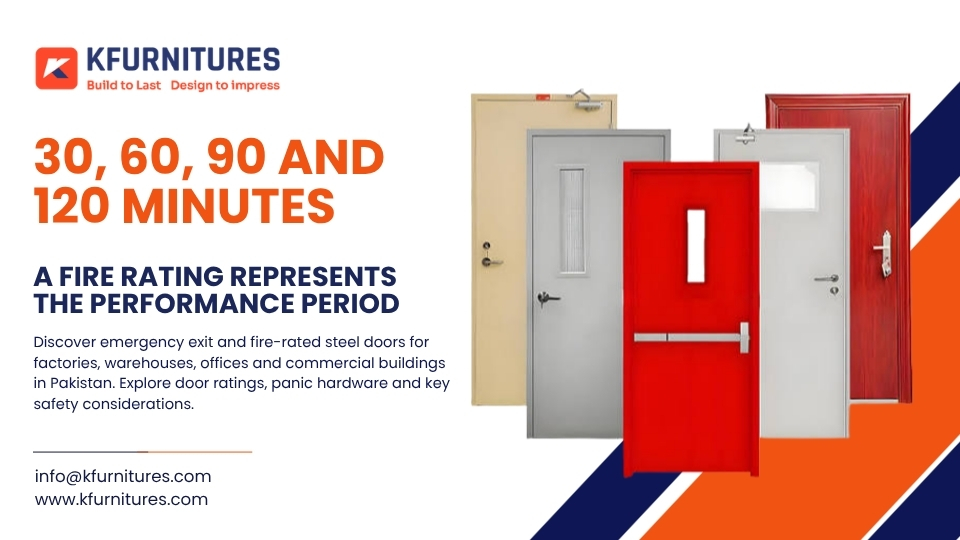
An emergency exit door is a critical safety component designed to provide a fast, secure, and accessible escape route during a fire, emergency, or other hazardous situation. In commercial buildings, factories, warehouses, offices, hospitals, schools, shopping centres, hotels, and industrial facilities, the right emergency exit door can help occupants evacuate quickly while supporting the building’s overall fire-safety strategy.
For businesses in Pakistan, selecting an emergency exit door is not simply about installing a door marked EXIT. The door assembly, fire resistance, hardware, installation, access requirements, and intended application all need to be considered.
KFurnitures manufactures steel emergency exit and fire-rated door solutions for commercial and industrial applications, helping businesses create safer and more dependable emergency escape routes.
What Is an Emergency Exit Door?
An emergency exit door is a door installed as part of a building’s designated emergency escape route. It allows occupants to leave a building quickly when normal entrances or internal routes cannot safely be used.
Depending on the building and application, an emergency exit door may incorporate:
- Panic exit hardware
- Push bars
- Fire-rated door leaves
- Steel construction
- Fire-resistant cores
- Heavy-duty hinges
- Self-closing mechanisms
- Emergency exit signage
- Appropriate locks and access-control hardware
- Smoke and fire seals
The exact specification should be determined according to the building’s design, occupancy, applicable regulations, and fire-safety requirements.
Emergency Exit Door vs. Fire-Rated Door
These terms are often used interchangeably, but they describe different functions.
An emergency exit door primarily refers to the door’s role in providing an escape route.
A fire-rated door refers to a door assembly that has been tested and rated for resistance to fire for a specified period under a particular test standard.
A door can therefore be part of an emergency escape route while also being fire-rated.
For example, a factory may require a steel emergency exit door that provides rapid egress while also helping restrict the spread of fire between designated areas.
Simple Difference
| Feature | Emergency Exit Door | Fire-Rated Door |
|---|---|---|
| Main purpose | Safe evacuation | Fire/smoke compartmentation |
| Escape function | Yes | Not necessarily |
| Fire resistance | May or may not be fire-rated | Designed/tested for fire resistance |
| Panic hardware | Common | Application dependent |
| Used in escape routes | Yes | Can be |
| Suitable for industrial buildings | Yes | Yes |
For critical applications, businesses should specify a tested and certified door assembly appropriate to the required fire-resistance period and installation conditions.
Why Emergency Exit Doors Are Important
During an emergency, every second can matter.
A properly designed emergency exit route allows people to move from occupied areas toward a place of safety without unnecessary obstacles or delays.
Emergency exit doors are particularly important in buildings where large numbers of people may be present, including:
- Manufacturing facilities
- Warehouses
- Offices
- Shopping malls
- Hotels
- Hospitals
- Schools and universities
- Restaurants
- Commercial complexes
- Data centres
- Industrial plants
- Construction projects
- Distribution centres
For industrial facilities, emergency exit doors also need to withstand demanding operating environments while remaining functional when required.
Fire-Rated Emergency Exit Doors for Industrial Applications
Industrial environments can present additional fire-safety challenges because they may contain machinery, electrical equipment, combustible materials, chemicals, packaging, or large storage areas.
A fire-rated emergency exit door can form part of a building’s passive fire-protection strategy by helping separate areas and protect escape routes, subject to the door’s tested performance and correct installation.
KFurnitures’ steel door solutions can be specified for applications such as:
Factories
Manufacturing facilities often have large production areas with machinery, electrical systems and raw materials. Strategically positioned emergency exits can support planned evacuation routes.
Warehouses
Warehouses may contain high volumes of packaging, inventory and storage systems. Emergency exits need to remain accessible and clearly identifiable.
Commercial Buildings
Office buildings, retail facilities and commercial complexes require properly planned escape routes that occupants can understand and use quickly.
Industrial Plants
Heavy-duty steel emergency doors can be appropriate where durability and long-term performance are important considerations.
Key Features to Look for in an Emergency Exit Door
When purchasing emergency exit doors, businesses should evaluate more than appearance.
1. Steel Construction
Steel provides durability and is widely used for commercial and industrial door applications.
2. Fire Resistance
Where fire protection is required, specify the required fire-resistance period and verify that the complete door assembly has appropriate test evidence or certification.
Fire ratings commonly encountered in the industry include:
- 30 minutes
- 60 minutes
- 90 minutes
- 120 minutes
The appropriate rating depends on the building design and applicable requirements.
3. Panic Exit Hardware
Emergency exit doors in public or occupied buildings may require panic hardware so occupants can operate the door rapidly from the inside.
4. Self-Closing Mechanism
Fire doors commonly require controlled self-closing to return the door to its closed position after use.
5. Fire & Smoke Seals
Appropriate seals can help limit the passage of smoke and hot gases when the door is closed, depending on the tested door system.
6. Heavy-Duty Hinges
Industrial doors may experience frequent operation, making suitable hinges and hardware important for reliability.
7. Clear Exit Identification
Emergency exits should be clearly identifiable and integrated with the building’s overall emergency signage and evacuation plan.
60, 90 and 120-Minute Fire-Rated Doors: What Do They Mean?
A fire rating represents the performance period established through an appropriate fire-resistance test for the specified door assembly.
For example:
60-minute fire-rated door
Designed/tested to provide the specified fire-resistance performance for 60 minutes under the applicable test conditions.
90-minute fire-rated door
Provides the specified tested performance for 90 minutes.
120-minute fire-rated door
Provides the specified tested performance for 120 minutes.
The rating should never be selected simply because a higher number sounds safer. The correct specification depends on the building’s fire strategy, wall rating, occupancy, location of the opening, local requirements, and applicable standards.
Where Should Emergency Exit Doors Be Used?
Emergency exit doors can be required or appropriate in many types of facilities, including:
- Factories
- Warehouses
- Offices
- Schools
- Hospitals
- Hotels
- Restaurants
- Shopping centres
- Industrial buildings
- Commercial plazas
- Storage facilities
- Distribution centres
- Manufacturing plants
The number and location of exits should be determined during building design and according to applicable fire and life-safety requirements.
Emergency Exit Doors for Businesses in Pakistan
Businesses operating in Pakistan should consider emergency evacuation requirements when designing or upgrading their facilities.
For projects in Karachi, Lahore, Islamabad, Rawalpindi, Faisalabad, Multan, Peshawar and other industrial and commercial centres, door specifications should be coordinated with the project’s architect, fire-safety consultant, engineer and relevant authority.
For large projects, procurement teams should request technical documentation covering the proposed door construction, hardware, dimensions, fire rating and applicable testing/certification.
How to Choose the Right Emergency Exit Door
Before purchasing an emergency exit door, consider these questions:
1. What type of building is it?
Factory, warehouse, office, hospital, hotel, school or commercial facility?
2. How many people use the building?
Occupancy affects evacuation planning and exit requirements.
3. Is fire resistance required?
If yes, determine the required rating before ordering.
4. What hardware is required?
Panic bars, exit devices, door closers, locks and access-control systems may vary by application.
5. What are the door dimensions?
The opening size and wall construction should be confirmed before fabrication.
6. Which standard applies?
The applicable fire and egress standard should be identified for the project.
7. Is the complete door assembly tested?
For fire-rated applications, ask for relevant test reports or certification rather than relying only on a manufacturer’s marketing claim.
8. Who will install the door?
Installation can affect the real-world performance of a fire-rated door assembly.
Why Choose Steel Emergency Exit Doors?
Steel emergency doors are widely used in commercial and industrial environments because they combine durability with practical maintenance requirements.
Depending on their design and specification, steel doors can provide:
- Strong construction
- Long service life
- Resistance to heavy usage
- Professional appearance
- Custom dimensions
- Compatibility with commercial hardware
- Suitable fire-rated configurations
- Low-maintenance surfaces
For industrial projects where doors may experience frequent operation, impact and demanding environmental conditions, the construction quality and hardware selection are particularly important.
KFurnitures Emergency Exit & Fire-Rated Door Solutions
KFurnitures provides steel door manufacturing solutions for commercial and industrial projects in Pakistan.
Our solutions can be developed for applications requiring:
- Emergency exit doors
- Fire-rated doors
- Steel doors
- Industrial doors
- Commercial building doors
- Factory emergency exits
- Warehouse emergency exits
- Fire-resistant door assemblies
- Panic exit door configurations
From individual replacement doors to larger commercial and industrial projects, specifications can be developed according to project requirements.
Looking for emergency exit doors for your factory, warehouse, office, commercial building or industrial project? Contact KFurnitures to discuss your required door size, fire rating, hardware and application.
Frequently Asked Questions About Emergency Exit Doors
What is an emergency exit door?
An emergency exit door is a door forming part of a designated escape route, allowing building occupants to evacuate during a fire or other emergency.
Are emergency exit doors fire-rated?
Not necessarily. An emergency exit door can be fire-rated when the application requires fire resistance. Fire rating and emergency egress are separate characteristics.
What is a fire-rated emergency exit door?
It is an emergency exit door that is also part of a tested fire-resistant door assembly designed to provide a specified level of fire resistance for a specified period.
What are common fire-rated door ratings?
Common ratings include 30, 60, 90 and 120 minutes, although the appropriate rating depends on the project and applicable requirements.
What is a panic bar on an emergency exit door?
A panic bar, or panic exit device, is hardware designed to allow occupants to open an exit door quickly by applying pressure to the horizontal bar.
Can emergency exit doors be made from steel?
Yes. Steel is commonly used for commercial and industrial emergency and fire-door applications because of its strength and durability.
Are fire-rated doors suitable for factories?
Fire-rated doors can be used in factories where required as part of the building’s fire-safety strategy. The required specification depends on the location and project design.
How do I select an emergency exit door for a warehouse?
Consider occupancy, escape-route requirements, door dimensions, fire rating, hardware, environmental conditions and the applicable building/fire-safety requirements.
Where can I buy emergency exit doors in Pakistan?
Businesses can source emergency exit and fire-rated steel doors from specialist manufacturers such as KFurnitures, with the final specification determined by the project’s requirements.
Emergency Exit Door — Key Takeaway
An emergency exit door is more than a conventional door with an EXIT sign. For commercial and industrial buildings, the complete system—including the door leaf, frame, hardware, seals, closer, installation and applicable fire/egress requirements—needs to be considered.
For factories, warehouses, offices, hospitals, commercial buildings and other facilities in Pakistan, selecting the appropriate steel emergency exit or fire-rated door can be an important part of an overall life-safety strategy.
KFurnitures manufactures steel emergency exit and fire-rated door solutions for commercial and industrial applications in Pakistan.
Need emergency exit doors for your project? Contact KFurnitures for a project-specific quotation and technical specification.










 Huzefa Khambati - Partner