
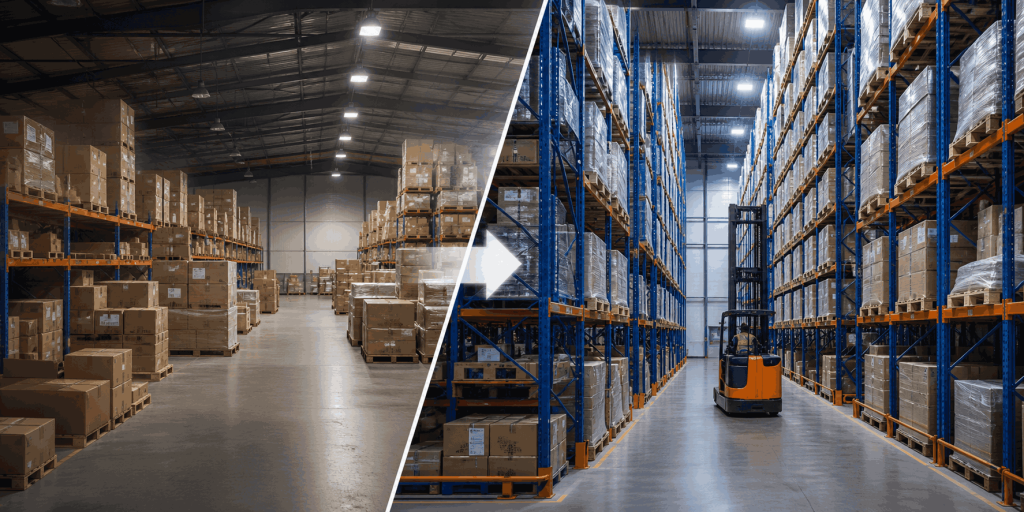
Walk into a typical warehouse and you’ll often see the same problem hiding in plain sight: unused vertical space. While floor space is treated as premium real estate, the height of the facility—often the most scalable dimension—remains largely untapped. This gap between available space and utilized space is where efficiency is lost, costs rise, and growth gets restricted.
The Real Problem: Thinking in Square Feet Instead of Cubic Capacity
Most warehouse layouts are designed with a 2D mindset. Pallets are stacked conservatively, shelving is installed without long-term planning, and aisles are spaced based on habit rather than data. The result?
- High floor footprint consumption
- Limited storage density
- Increased travel time for picking and restocking
- Operational bottlenecks during peak hours
In short, warehouses run out of space—not because they lack it, but because they don’t use it effectively.
Why Vertical Space Goes Unused
There are a few consistent reasons behind poor vertical utilization:
1. Standard Shelving Limitations
Basic shelving systems aren’t engineered for height, load distribution, or accessibility at scale. They cap growth early.
2. Safety Concerns
Without proper load-rated systems, stacking higher becomes risky. Businesses choose safety over optimization—rightfully so.
3. Equipment Constraints
Not all facilities are equipped with the right material handling equipment (like reach trucks or VNA forklifts) to operate at height.
4. Poor Layout Planning
Warehouses evolve over time. Without structured planning, they become patchworks of temporary fixes rather than optimized systems.
What Purpose-Built Racking Systems Do Differently
This is where engineered storage solutions change the game. Instead of adapting operations to space limitations, they adapt space to operational needs.
1. Designed for Vertical Efficiency
Systems like Selective Racking, VNA (Very Narrow Aisle), and Long Span Shelving are built to maximize height safely. They allow warehouses to utilize up to 80–90% of available vertical space, compared to the typical 40–50%.
2. Load-Engineered for Safety
Every beam, frame, and connector is designed with specific load ratings, ensuring that increasing storage height doesn’t compromise structural integrity.
3. Optimized Aisle Planning
With solutions like VNA racking, aisle width is reduced without sacrificing accessibility. This means:
- More racks per square foot
- Faster inventory movement
- Reduced congestion
4. Scalable & Modular Design
Purpose-built systems grow with your business. Whether you expand product lines or increase volume, your storage system adapts without requiring a full redesign.
5. Faster Inventory Access
Smart racking layouts reduce picking time, improve visibility, and streamline operations—turning storage into a productivity tool, not a limitation.
Businesses that shift to engineered racking systems typically see:
- 30–60% increase in storage capacity (without expanding floor space)
- Significant reduction in floor footprint usage
- Improved inventory accessibility and picking speed
- Better warehouse flow and reduced bottlenecks
Your warehouse doesn’t need more space—it needs a smarter way to use the space it already has.
If vertical capacity is underutilized, you’re effectively leaving money, efficiency, and growth potential on the table. Purpose-built racking systems aren’t just storage—they’re infrastructure for scalability.
Ready to unlock the full potential of your warehouse?
Request a Free Warehouse Layout Assessment and discover how much capacity you’re missing—and how quickly you can recover it.










 Huzefa Khambati - Partner