
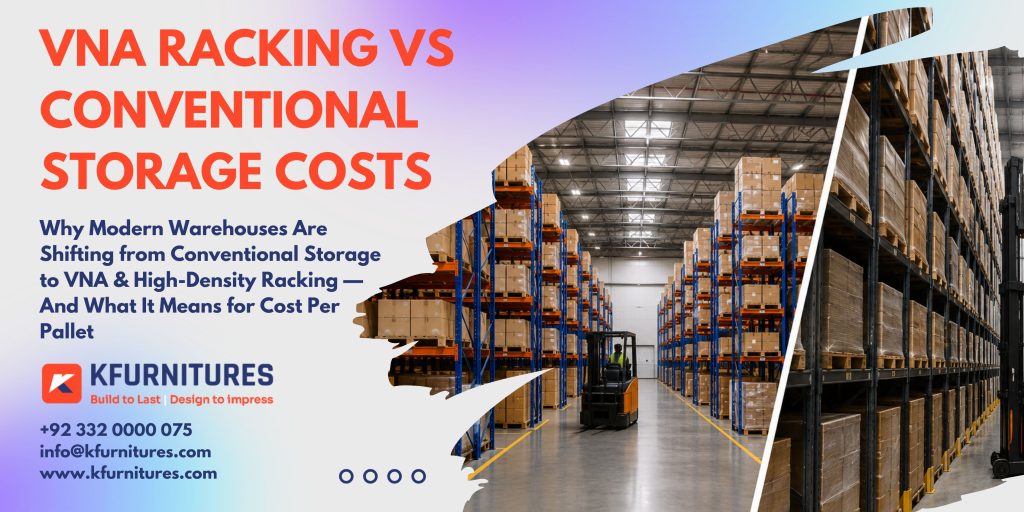
Why Modern Warehouses Are Shifting from Conventional Storage to VNA & High-Density Racking — And What It Means for Cost Per Pallet
In today’s supply chain environment, warehouse space is becoming more expensive while inventory demands continue to grow. Many operations managers are discovering that the real limitation is not warehouse size — it is storage efficiency.
If your facility is running out of capacity, the issue usually comes down to one of these three factors:
- Limited floor space
- Inefficient warehouse layout
- Slow access and material handling time
This is why modern warehouses are rapidly shifting from conventional storage systems to VNA (Very Narrow Aisle) and high-density racking systems.
For operations teams, the goal is no longer just storing more pallets. The focus is reducing cost per pallet, improving throughput, and maximizing every square foot of warehouse space.
What Is Limiting Your Warehouse Storage Capacity?
Many warehouses still operate with conventional selective pallet racking layouts that were designed years ago for lower inventory volumes and simpler operations.
The problem is that traditional layouts consume too much floor area because of:
- Wide forklift aisles
- Underutilized vertical space
- Low pallet density
- Inefficient picking paths
As inventory increases, companies often assume they need a larger warehouse. In reality, many facilities already have unused cubic storage capacity above existing racks.
Modern racking strategies focus on using vertical height and optimized aisle widths to unlock additional pallet positions without expanding the building footprint.
What Is VNA Racking?
VNA (Very Narrow Aisle) racking is a high-density warehouse storage solution designed to reduce aisle width while increasing pallet storage capacity.
Unlike conventional racking systems that require wide aisles for standard forklifts, VNA systems use specialized forklifts or turret trucks that can operate in much narrower aisles.
This allows warehouses to:
- Add more racking rows
- Increase pallet positions
- Improve vertical utilization
- Reduce storage cost per pallet
In many facilities, VNA layouts can increase storage density by 30% to 50% compared to conventional pallet racking.
Conventional Storage vs VNA Racking
Aisle Width Comparison
Traditional warehouses often operate with aisle widths between:
- 3.5m to 4m for counterbalance forklifts
VNA systems typically reduce aisle widths to:
- 1.6m to 2m depending on equipment type
That reduction creates substantial additional storage space across the warehouse floor.
Example:
A warehouse with 10 conventional aisles may fit 14–16 VNA aisles in the same footprint.
The result is significantly higher pallet density without moving to a larger facility.
Vertical Space Utilization: The Biggest Untapped Opportunity
One of the most overlooked warehouse assets is vertical space.
Many warehouses use only 40%–60% of available building height. High-density racking systems are specifically designed to maximize vertical cube utilization.
Typical Vertical Utilization
| Storage Type | Average Vertical Utilization |
|---|---|
| Conventional Racking | 40%–60% |
| VNA Racking | 75%–90% |
By increasing rack height and optimizing lift equipment, businesses can dramatically increase storage capacity within the same building footprint.
How High-Density Racking Reduces Cost Per Pallet
Warehouse operating costs are heavily tied to space utilization.
When pallet density improves, the cost of rent, utilities, labor, and facility operations gets distributed across more pallet positions.
Key Cost Advantages
1. Lower Warehouse Expansion Costs
Instead of leasing additional warehouse space, businesses can increase storage capacity inside the current facility.
2. Reduced Cost Per Pallet
Higher pallet density means lower storage cost per unit.
3. Improved Inventory Organization
Optimized layouts improve stock visibility and reduce wasted movement.
4. Better Operational Efficiency
Efficient aisle design shortens travel time and improves forklift productivity.
5. Reduced Warehouse Footprint
High-density systems allow businesses to store more inventory in smaller spaces.
This becomes especially important in urban industrial areas where warehouse rental rates continue to rise.
Forklift Compatibility in VNA Warehouses
One of the most important considerations when transitioning to VNA storage is forklift compatibility.
VNA systems typically require:
- Turret trucks
- Articulated forklifts
- Wire-guided or rail-guided VNA equipment
These forklifts are engineered for narrow aisle operation while maintaining lifting height and maneuverability.
Although specialized equipment requires investment, the long-term savings in warehouse space and operational efficiency often outweigh the initial cost.
Pallets Per Square Foot Improvement
Modern warehouse optimization is increasingly measured by pallets per square foot.
Average Storage Density Comparison
| Storage System | Pallets Per Sq Ft |
|---|---|
| Conventional Racking | Lower density |
| Double Deep Racking | Medium density |
| VNA Racking | High density |
| High-Density Automated Systems | Very high density |
In many warehouse redesign projects, VNA systems can improve pallet storage capacity by 40% or more within the same footprint.
Why Warehouse Managers Are Prioritizing High-Density Storage
Operations and warehouse managers are under constant pressure to:
- Reduce operational costs
- Improve inventory handling speed
- Increase storage capacity
- Support growing SKU counts
- Delay costly warehouse expansion projects
High-density racking systems directly support these goals.
Instead of relying on larger facilities, modern warehouse design focuses on smarter space utilization.
Is VNA Racking Right for Every Warehouse?
VNA systems are highly effective, but the ideal solution depends on:
- Inventory turnover rate
- SKU variety
- Building height
- Forklift operations
- Picking requirements
- Future scalability
Warehouses with high pallet volume and limited expansion space often achieve the greatest benefit from VNA implementation.
A professional warehouse layout analysis is essential before redesigning storage systems.
The Future of Warehouse Storage Is Vertical
As warehousing costs continue to rise, storage efficiency is becoming a competitive advantage.
Modern facilities are shifting away from conventional layouts toward:
- VNA racking
- High-density pallet systems
- Vertical warehouse optimization
- Smarter material handling strategies
The result is higher storage capacity, lower cost per pallet, and better operational performance — without increasing warehouse footprint.
Request a Warehouse Layout Consultation
At KFurnitures, we help businesses optimize warehouse performance with intelligent storage and racking solutions tailored to operational needs.
Whether you are planning a warehouse upgrade, increasing pallet capacity, or redesigning your storage layout, our team can help you identify the most efficient solution for your facility.
Request a Warehouse Layout Consultation today and discover how much storage capacity your warehouse may already be missing.










 Huzefa Khambati - Partner